9 Stained Glass Outline Stamps: A Practical Guide for Procreate Artists
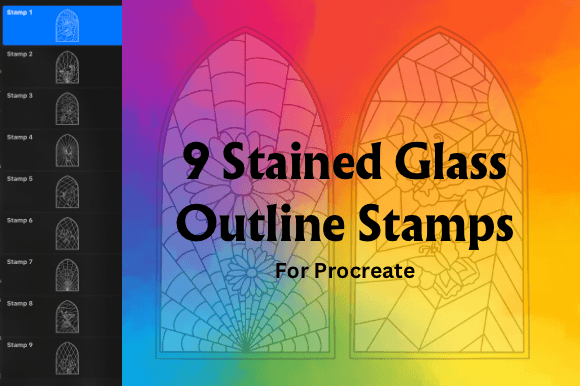
Digital illustration often requires a delicate balance between precision and organic flow, particularly when attempting to replicate traditional media like stained glass. For artists working within the Procreate ecosystem on iPad or iPhone, specialized tools can significantly streamline this process. The 9 Stained Glass Outline Stamps set offers a specific solution for creating lead lines, borders, and structural definitions without the labor of drawing every curve manually. This resource provides nine distinct stamp brushes designed to mimic the irregular, handcrafted look of lead cames found in authentic glasswork.
Understanding the utility of these stamps is essential before integrating them into a workflow. Unlike standard vector shapes or rigid geometric tools, these outline stamps are crafted to introduce subtle imperfections and texture. When an artist applies a single tap with one of the 9 Stained Glass Outline Stamps, it generates a segment that resembles a piece of lead lining. By rotating, scaling, and connecting these segments, users can construct complex window designs, jewelry patterns, or decorative borders that maintain a cohesive, artisanal aesthetic.
Defining the Distinctive Features of Stamped Outlines
The primary distinction of the 9 Stained Glass Outline Stamps lies in their approach to line creation. Traditional drawing methods in digital art often rely on pressure sensitivity to vary stroke width, which requires a steady hand and significant practice to achieve consistency. In contrast, these stamp brushes offer a modular approach. Each of the nine options presents a unique variation of the outline—some may be thicker, others thinner, some with rounded ends and others with sharper angles. This variety allows the artist to mix and match elements to avoid the repetitive "copy-paste" look that plagues many digital designs.
Furthermore, the texture embedded within these stamps is critical. Authentic stained glass outlines are not perfectly smooth; they possess a slight roughness and weight that defines the medium. The 9 Stained Glass Outline Stamps capture this nuance, providing a visual depth that flat vector lines often lack. This makes them particularly effective for artists who want to create illustrations that feel tactile and grounded in physical reality, even though they are created entirely on a digital tablet.
Comparing Stamps to Hand-Drawn Techniques
When evaluating whether to use the 9 Stained Glass Outline Stamps or rely on freehand drawing, several factors come into play. Freehand drawing offers absolute control over every pixel and allows for continuous, unbroken lines. However, it is time-consuming and can result in uneven spacing if the artist lacks experience. The stamp method sacrifices the fluidity of a continuous stroke for speed and uniformity of character.
For projects requiring rapid prototyping or intricate geometric patterns, the stamps provide a distinct advantage. An artist can quickly lay out a grid of lead lines using the 9 Stained Glass Outline Stamps and then fill the spaces with color, rather than spending hours perfecting the linework. Conversely, for highly organic, flowing designs where the lead lines need to twist and turn in unpredictable ways, a combination of stamps and manual adjustment might be necessary. Relying solely on stamps in such scenarios could result in a disjointed appearance if the segments do not align perfectly.
Evaluating Alternatives and Tool Categories
In the broader landscape of digital art resources, there are various alternatives to the 9 Stained Glass Outline Stamps. Some artists opt for vector-based design software like Adobe Illustrator, where paths can be manipulated with mathematical precision. While powerful, this approach often results in a sterile, overly clean look that lacks the charm of hand-crafted art. Other Procreate users might utilize built-in shape tools or third-party vector packs, but these often lack the specific textural qualities associated with stained glass.
Another common alternative is the use of textured brush sets that simulate paint or ink. While these can create beautiful effects, they do not provide the structural definition needed for stained glass outlines. The 9 Stained Glass Outline Stamps occupy a unique niche by combining the structural rigidity of a vector shape with the organic texture of a traditional medium. This hybrid nature makes them superior for specific applications where the "lead" line is the defining feature of the artwork.
It is also worth considering the difference between full brush sets and isolated stamp packs. Full brush sets often include dozens of variations, which can be overwhelming and clutter the workspace. The focused nature of the 9 Stained Glass Outline Stamps ensures that every tool provided serves a direct purpose. There is no bloat; each of the nine stamps is curated to work harmoniously with the others, facilitating a streamlined workflow for artists who value efficiency.
Strengths and Tradeoffs in Digital Workflows
The strengths of the 9 Stained Glass Outline Stamps are clear: speed, consistency, and aesthetic authenticity. They allow artists to bypass the tedious process of drawing repetitive lines while maintaining a high level of detail. This is particularly beneficial for commercial projects with tight deadlines or for hobbyists who wish to experiment with complex designs without mastering advanced drawing techniques.
However, tradeoffs exist. Because these are pre-made assets, there is a risk of overuse. If an artist relies too heavily on the same few stamps without varying rotation, size, or opacity, the final image may appear mechanical. Additionally, the requirement to connect individual stamps means that the artist must pay close attention to alignment. Gaps or overlaps between stamps can break the illusion of a continuous lead line, requiring careful editing.
Another limitation is the platform dependency. These tools are specifically designed for Procreate on iPad or iPhone. Artists working on desktop computers or using other applications like Clip Studio Paint or Photoshop cannot directly utilize these files without conversion, which may alter their properties. This restricts their utility to the Apple ecosystem, a factor that must be weighed against the benefits they offer within that environment.
Decision Factors: When to Use These Stamps
Determining when the 9 Stained Glass Outline Stamps are the right choice depends largely on the project's goals. They are ideal for creating pattern swatches, textile designs, wallpaper textures, and illustrative backgrounds where the stained glass motif is central. They are also excellent for educational purposes, allowing students of art to understand the structure of leaded glass without needing physical materials.
If the objective is to create a hyper-realistic photograph of a stained glass window, these stamps may fall short. Photorealism often requires more complex lighting simulations and surface details that simple outline stamps cannot provide. In such cases, a more comprehensive 3D modeling approach or a highly detailed painting technique would be more appropriate. Similarly, if the design requires custom, non-standard shapes that cannot be formed by arranging the available nine stamps, the artist may need to supplement these tools with custom-drawn elements.
For most general illustration tasks, however, the 9 Stained Glass Outline Stamps offer a compelling middle ground. They provide enough flexibility to create diverse compositions while offering the efficiency of pre-designed assets. Artists should consider their own skill level and the specific requirements of their project before deciding. If the goal is to produce high-quality, stylistic art efficiently, these stamps are a valuable asset. If the goal is total creative freedom without constraints, a purely hand-drawn approach might be preferable.
Licensing, Usage Rights, and Ethical Considerations
A critical aspect of utilizing any digital asset is understanding the licensing terms. The 9 Stained Glass Outline Stamps are provided for personal use only. This restriction is a fundamental boundary that users must respect. It means that the brushes can be used to create personal artwork, practice pieces, or non-commercial projects, but they cannot be sold, distributed, published, shared, or posted online as standalone files.
This policy extends to the integrity of the design itself. Users are explicitly prohibited from claiming these stamp brushes as their own designs. Even modifying a single stamp does not grant ownership rights. Furthermore, distributing just one of the nine stamps, or sharing the entire pack with others, violates the terms of use. This includes posting the files on file-sharing platforms, social media groups, or selling them on marketplaces.
These restrictions are in place to protect the intellectual property of the creator. When artists purchase or download such resources, they are acquiring a license to use the tool, not ownership of the tool itself. Adhering to these guidelines ensures that the creator can continue to develop new resources and that the community remains fair and ethical. For professionals, it is vital to distinguish between using a brush to create a sellable *image* (which is generally permitted under personal use licenses) and selling the *brush file* itself (which is strictly forbidden).
Before incorporating the 9 Stained Glass Outline Stamps into any workflow, users should review the specific license agreement provided with the download. If there is any ambiguity regarding a specific use case, such as using the resulting artwork in a commercial client project, seeking clarification from the creator is the prudent course of action. Respecting these boundaries fosters a sustainable environment for digital artists and resource creators alike.
Final Thoughts on Integration
The 9 Stained Glass Outline Stamps represent a targeted solution for a specific artistic need within the Procreate community. By offering a blend of speed, texture, and stylistic accuracy, they enable artists to achieve professional-looking results with less effort. However, their effectiveness depends on how they are integrated into the broader creative process. Used thoughtfully, they enhance the workflow; used indiscriminately, they can limit creative expression.
Ultimately, the decision to use these stamps should be based on a clear understanding of their capabilities, limitations, and legal constraints. For those working within the specified parameters and seeking to explore the aesthetics of stained glass digitally, this set provides a robust foundation. As with any tool, the quality of the final output rests not just on the asset itself, but on the skill and intention of the artist wielding it.